
Cargo and equipment · Importer / Exporter / Freight forwarder
Damaged cargo in a container: document the condition at receipt
Record the observed condition safely, organise photographs and documents, and notify the relevant parties under the applicable procedure.
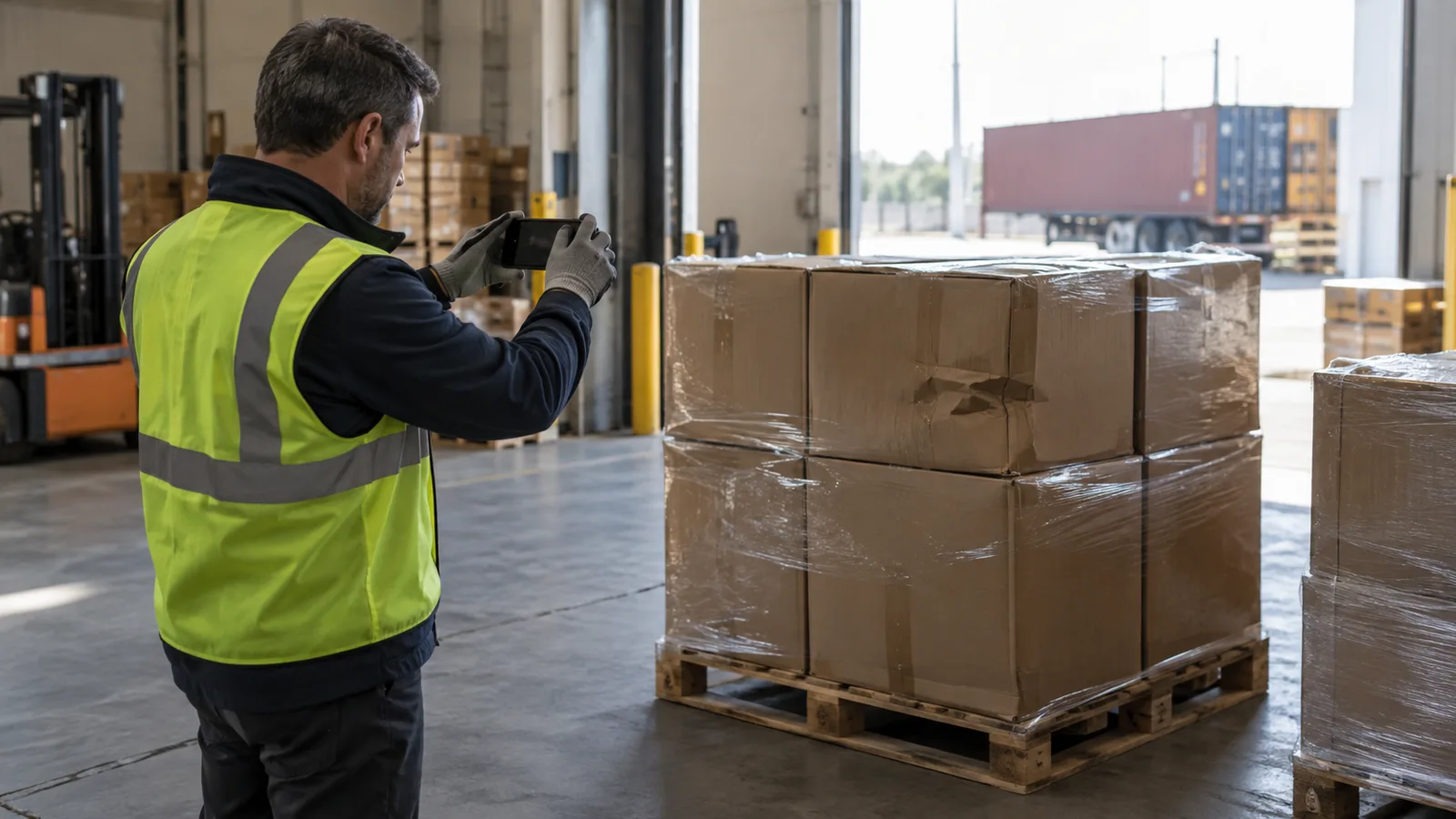
Prepare an evidence pack and prompt notification without assuming the cause.
You open a container and see damaged packaging. First protect people and goods, then record the condition and promptly check the correct notification channels. Do not start by assigning blame from one photograph.
Evidence should show what was observed, when and where. Cause, extent and responsibility may need further inspection.
Safety comes before photographs
If cargo is unstable or there is leakage, an unfamiliar smell or suspected danger, do not enter or move packages yourself. Restrict access under the site's procedure and involve the appropriate people.
Do not delay urgent safety measures for an ideal photograph. If changes are necessary to reduce loss, record what was done, why, when and by whom.
Capture context and detail
Where safe, take an overall view and close-ups. Link them to the container, cargo unit and position in the load. Retain original files rather than only edited images.
Record date, time, opening location and participants. Include any available observations of doors, seal and exterior before opening. Do not invent checks nobody performed.
An intact seal does not itself prove sound cargo. A different seal needs investigation but does not automatically prove theft; check any documented replacement.
Evidence checklist
| Material | Purpose |
|---|---|
| Overall and detailed photographs | Condition and position of affected units |
| Container, seal and package identifiers | Link evidence to the shipment |
| Receipt record with remarks | Record observed discrepancies |
| Invoice and packing list | Identity, quantity and valuation basis |
| Bill or other transport document | Identify carriage and relevant parties |
| Loading records | Available evidence of initial condition |
| Special records | Relevant temperature data, for example, if available |
| Timeline and correspondence | Discovery and subsequent actions |
Do not wait for every attachment before the first notification. Identify available evidence and planned additions.
Describe observations without guessing
In a fictional example, three cartons near the doors are crushed on one side. A factual note says: “Three cartons in the door area show deformation; contents not yet inspected.”
“The carrier damaged three products at sea” adds cause, responsibility and product condition that the observation does not establish. Add inspection results later, keeping them distinct from the first observation.
Likewise, visible wetting does not identify the water source. Do not test an unknown substance unsafely for the claim.
Remarks, notification and valuation are separate steps
Record discrepancies in the receipt documentation under the relevant procedure. Do not provide an unqualified confirmation of a condition not checked or subject to specific concerns. Retain the remarks supplied.
Notify the relevant carrier contact and insurer where a policy exists. One notification may not replace the other. Check deadlines and required channels immediately; there is no single deadline for all contracts and jurisdictions.
Initial notice can precede full claim valuation. Keep the case reference and acknowledgement, then provide further evidence as instructed.
Inspection and loss reduction
Agree whether a surveyor or joint inspection is needed. Hapag-Lloyd describes such steps in its claims procedure; check other operators and the policy separately.
Do not immediately discard packaging or damaged parts that can safely be retained. Equally, do not leave goods in conditions that increase danger or loss. Coordinate necessary mitigation and document it.
Product suitability, repair, salvage sale or disposal may require further decisions. A surveyor attending is not a payment promise.
Initial notification
I report a discrepancy on receipt of [document/container] at [place] on [date/time]. Observed facts: [details]. Contents and cause: [confirmed/not established]. Protective actions: [what/why]. Available evidence: [list]; further documents: [list]. Please acknowledge, provide a case reference, confirm procedure and deadlines, and advise whether inspection is required before further handling.
Sources and scope
- Hapag-Lloyd — Cargo ClaimsSource checked: 2026-09-13
Carrier procedure: photographs, notification, inspection and case-dependent documents. Advertised response times are not payment guarantees.
- Chubb — Quick Cargo 2023 policy example, via Hapag-LloydSource checked: 2026-09-13
2023 policy example, not evidence of current product availability. Illustrates scope, exclusions, endorsements and duties; no universal limits or deadlines.
- IMO/ILO/UNECE — CTU Code 2014, full textSource checked: 2026-09-13
2014 edition, chapters 8–9 and 11–13, annex 3: inspection, packing, moisture, securing and competence. The status of any later revision requires a separate check.
- Maersk — Terms for CarriageSource checked: 2026-09-13
This carrier’s carriage contract, subject to applicable law. Tariff, procedures, liability and claims cannot be inferred from the freight price alone.
Editorial information
Author: WR
Published · Published: 13/09/2026 · Content updated: 13/09/2026