
Cargo and equipment · Importer / Exporter / Freight forwarder
Open top or flat rack? Prepare an oversized cargo enquiry
Prepare transport dimensions, weights, drawings and handling requirements for an oversized cargo assessment.
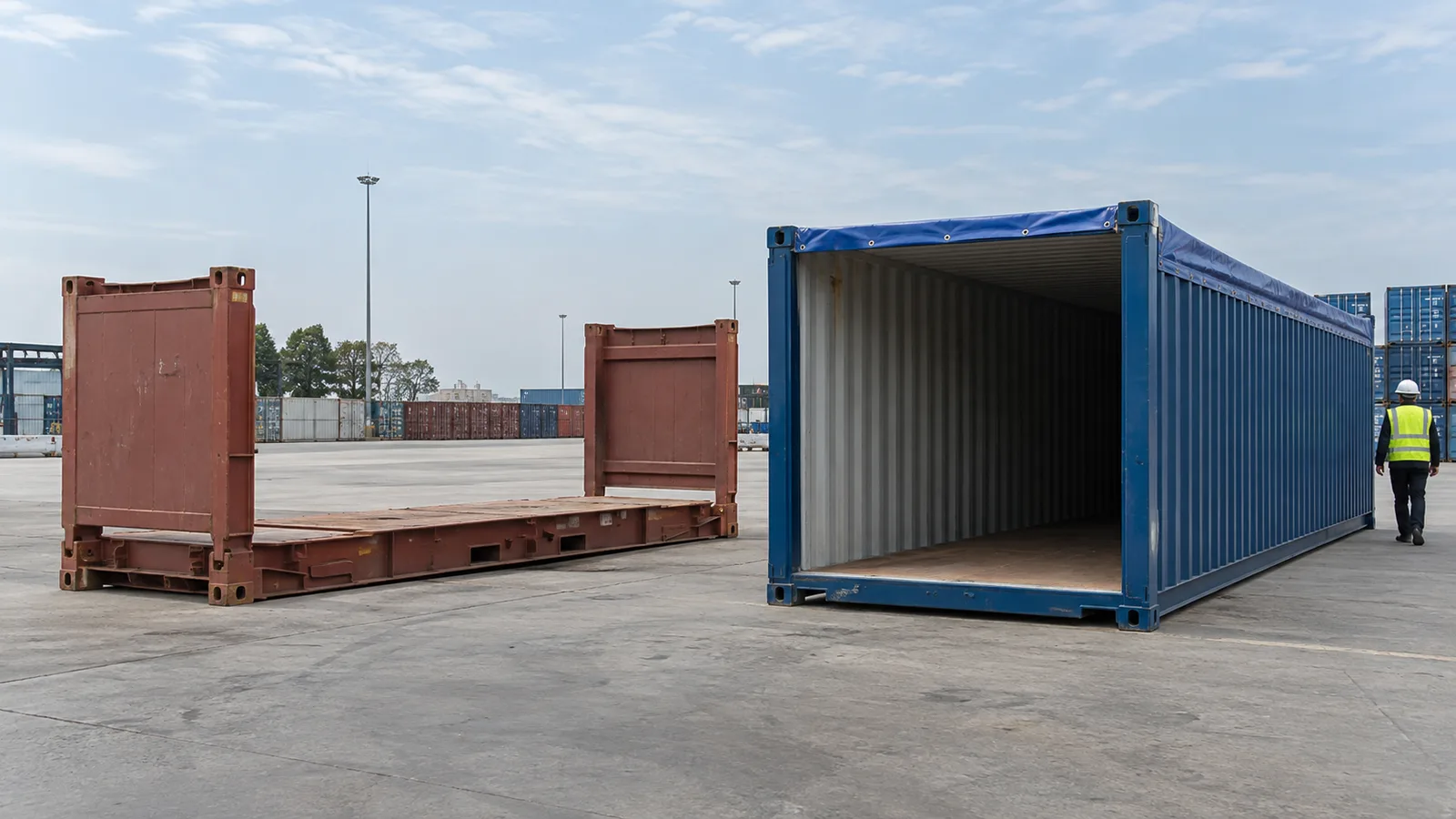
Assemble a consistent information pack for equipment and route assessment.
Do not select equipment from a machine name alone. Assessing an open top or flat rack requires transport dimensions, weight, support geometry and handling information. “A machine weighing a few tonnes” is not enough to confirm a solution.
Start with one current specification showing what will actually travel, how it will be lifted and where loading and unloading will take place.
Understand the equipment choices
An open top permits loading from above but still has a structure that limits usable space. An opening roof does not mean unlimited width or acceptance of any cargo height.
A flat rack has no conventional side walls or roof. It still has its own supporting structure and restrictions. Missing side walls do not remove transport limits.
OOG means out of gauge: cargo extending beyond the agreed equipment envelope. Establish which unit and reference points were used to measure overhang. Selecting a flat rack does not itself establish the amount of overdimension.
Some cargo needs another solution, such as breakbulk carriage. Allow the specialist to propose an option instead of forcing an equipment choice made without sufficient data.
Product dimensions are not transport dimensions
A machine catalogue may exclude the base, covers and packaging. The enquiry needs the external envelope in the actual shipping condition. Identify removable parts and who will dismantle and reassemble them.
In a fictional example, a manufacturer first supplies a drawing without packaging. The warehouse later adds a base and protection around a projecting component. A quote based on the first drawing needs review; calling the dimensions “approximate” does not resolve the discrepancy.
Give the specification a version and date. If packing is incomplete, identify estimated values and when final measurements will become available. Do not label an estimate as final.
Build the information pack
| Information | What to provide |
|---|---|
| Identification | Equipment description, quantity and shipping condition |
| Dimensions | External length, width and height including base and packaging; units |
| Weight | Gross weight per piece and confirmation source |
| Geometry | Drawing with views, centre of gravity and supports where required |
| Handling | Confirmed lifting and securing points; orientation restrictions |
| Protection | Product requirements for rain, moisture and covers |
| Route | Full addresses, ports, access and available handling equipment |
| Timing | Readiness, loading window and required delivery date |
Photographs should match the drawing version. Identify components that must not be used for lifting where the instructions say so. Do not treat securing points as lifting points without the designer's confirmation.
Check the route beyond the vessel
Sea carriage feasibility does not establish access to the factory. Road equipment, infrastructure, relevant permits and terminal capabilities need separate assessment in the countries concerned.
Ask who arranges cranes, supports and handling at each end. A port-to-port quote can exclude substantial work. Confirm availability of the special equipment for the required date, not merely its presence in a catalogue.
Separate pricing, securing design and acceptance
A quote may be conditional. Look for outstanding documents, acceptance conditions and the party responsible for confirming them.
Ask about securing design, possible inspection and required certificates. Hapag-Lloyd's example requirements vary by ports and conditions. Do not automatically apply that list to another carrier or treat a certificate as a substitute for correct execution.
This article, its AI illustration and a preliminary visualisation are not lifting or securing designs. The 3D planner can help organise geometry where it supports the relevant equipment. It does not establish carrier acceptance of OOG cargo or whole-route feasibility.
Reassess changes after quotation
If the base, weight, projecting parts or handling method changes, circulate the revised pack to everyone assessing the shipment. Request confirmation of the effect on price, sailing, inland transport and earlier approvals.
Do not authorise loading on the strength of “it looks similar”. Record the specification version covered by final confirmation.
Enquiry to copy
Please assess [commodity and pieces] from [addresses and ports]. Attached: transport specification [version/date], packed dimensions, weights, drawings and confirmed lifting/support information. Cargo ready: [date]. Propose equipment and confirm quotation scope, availability, required documents, inland restrictions and final acceptance conditions. Information still estimated: [items and confirmation date].
Sources and scope
- Hapag-Lloyd — Special Cargo QuotesSource checked: 2026-09-13
Hapag-Lloyd special-cargo enquiries. Transport dimensions and route information are needed; quotation and technical cargo acceptance require specific assessment.
- Hapag-Lloyd — Special CargoSource checked: 2026-09-13
Carrier equipment options and information for special-cargo assessment; no shipment-specific approval.
- Hapag-Lloyd — Lashing Certificate Requirements V1.2Source checked: 2026-09-13
Carrier-specific certificate requirements vary by ports and conditions. Port tables and thresholds are not reproduced.
Editorial information
Author: WR
Published · Published: 13/09/2026 · Content updated: 13/09/2026