
Cargo and equipment · Importer / Exporter / Freight forwarder
Heavy cargo with little volume: check the whole route
Why container payload alone cannot approve heavy cargo: support, inland transport, terminal handling and unloading.
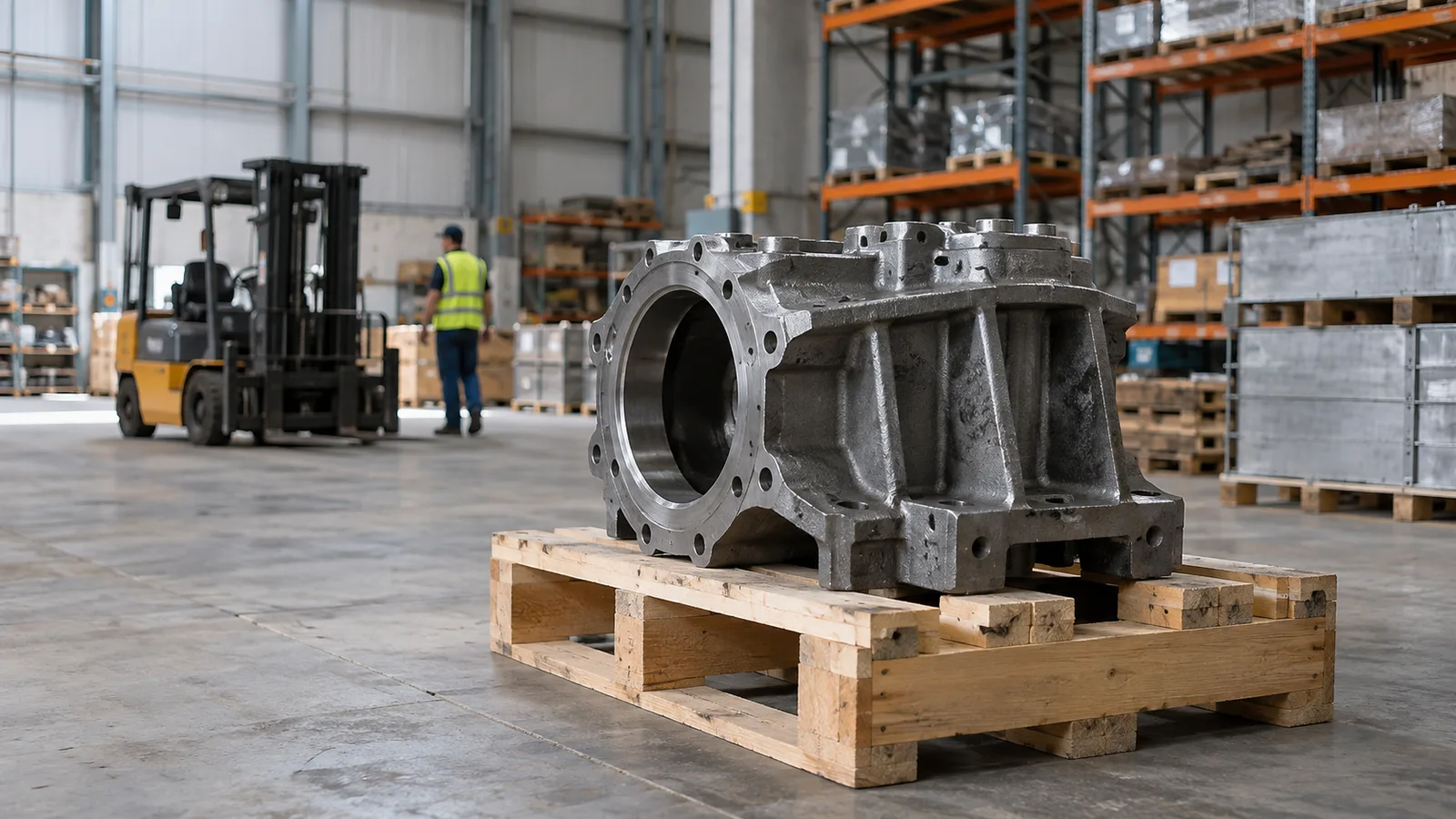
Collect section-by-section confirmations before ordering transport.
Low CBM does not mean straightforward transport. A heavy item may fit inside a container yet require different support, inland equipment or handling. Assess the complete route before deciding.
Ask more than “how many tonnes can the container take?”. Establish the actual transported mass and where it acts on the structure and vehicles.
Separate the different weights
Net product weight excludes packaging and other items loaded with it. Assess cargo gross weight including packaging and base, plus additional loading materials.
Container maximum gross mass and tare are different values. Their difference gives an initial payload limit from those figures; it does not approve any load arrangement or road movement.
Verified gross mass, VGM, of the packed container serves a separate pre-vessel-loading requirement. A correct VGM submission does not replace assessment of the floor, vehicle axles or handling equipment.
Small support points can change the outcome
The same weight spread over a long base or concentrated on small feet creates different loading conditions. Provide actual support geometry, spacing, resting length and centre of gravity where needed.
Hapag-Lloyd's weight-distribution guidance distinguishes floor and equipment designs. Do not take one table value as universal for every unit. Confirmation must address the proposed container and actual load arrangement.
Do not design supports by casually swapping timber for steel or adding beams. Support and securing design belong with the competent people preparing the solution. The illustration is not a construction example.
A fictional unresolved shipment
Assume a casting and base weigh 18,000 kg. The initially selected container has sufficient catalogue payload. That still does not establish whether the actual supports, floor, road transport and factory receipt make the shipment feasible.
The 18,000 kg figure is an example assumption, not a universal heavy-cargo threshold or permitted limit. It cannot authorise use of a particular container.
If the supplier supplied an estimate instead of a confirmed weight, record when and how it will be verified. Keep the overall assessment open until the missing result is resolved.
Route-check table
| Element or leg | Confirmation needed | Responsible party |
|---|---|---|
| Packaging and support | Mass, geometry and permitted handling | Manufacturer and solution designer |
| Container | Actual parameters and loading arrangement acceptance | Equipment provider or specialist |
| Transport to port | Vehicle, weight distribution, route and local conditions | Inland carrier |
| Terminals | Acceptance and handling capability | Operator through the agreed contact |
| Sea leg | Cargo and equipment acceptance | Ocean carrier |
| Final delivery | Route, factory access and unloading | Haulier and consignee |
Record the date, conditions and specification version for each answer. A “yes” for the container does not complete the other rows.
Road mass includes more than cargo
Road assessment concerns the appropriate vehicle combination with container and cargo, including load distribution. Permitted weights and requirements depend on jurisdiction, configuration and route.
Request confirmation of the actual arrangement, not a general “we transport heavy containers”. Include access to both warehouses and any required permissions. No single road limit is given here for different countries.
Agree unloading before dispatch
The consignee must confirm equipment, working space and how the cargo will be received. Delivering a heavy unit to a ramp does not prove that the available forklift or floor is suitable.
Identify responsibility for extra equipment, waiting and possible rescheduling. If unloading needs a design or specialist crew, include it in the plan and quotation scope.
Use the planner as supporting information
Check the arrangement of your units in Cargexo's 3D planner using confirmed dimensions and weights. Retain the assumptions. Geometric fit and a tool's weight indicator are not certificates of floor capacity, axle loading or securing design.
Use the output to support discussions with operators. Where the tool does not model a support or restriction, document it and arrange a separate assessment.
Confirmation request
Shipment: [cargo], gross weight with base and packaging [value], dimensions [values], specification [version]. Please confirm feasibility of your leg using the stated equipment, actual supports and route. Identify required calculations, permissions, documents, extra equipment and costs outside the basic quotation. Dimensional fit or catalogue payload alone does not complete the assessment.
Sources and scope
- Hapag-Lloyd — Weight Distribution GuidelineSource checked: 2026-09-13
Support length and floor construction matter in addition to total weight. Carrier tables and support designs are not reproduced.
- IMO/ILO/UNECE — CTU Code 2014, full textSource checked: 2026-09-13
2014 edition, chapters 8–9 and 11–13, annex 3: inspection, packing, moisture, securing and competence. The status of any later revision requires a separate check.
- IMO — Verification of the gross mass of a packed containerSource checked: 2026-09-13
SOLAS VI/2, applicable requirement from 1 July 2016. The shipper provides verified gross mass including tare, packaging and securing material; VGM does not guarantee vessel space.
Editorial information
Author: WR
Published · Published: 13/09/2026 · Content updated: 13/09/2026