
Shipment operations · Importer / Exporter / Freight forwarder
Truck or rail from the port? Compare the whole delivery
Compare inland delivery including the inland terminal, final road leg, availability and empty-container return.
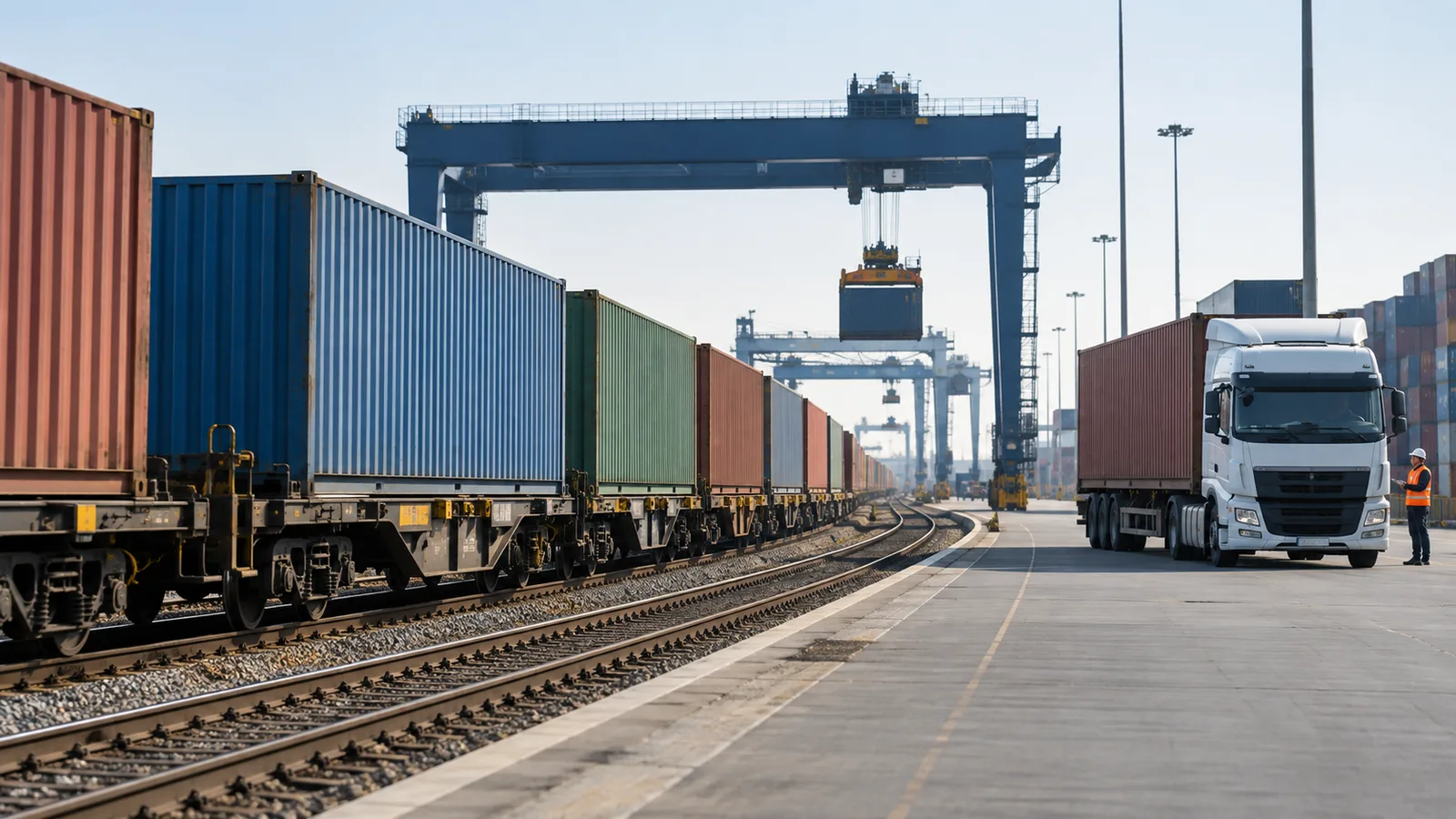
Put inland options on the same scope and check the actual warehouse delivery date.
Compare warehouse delivery dates, not only train and truck running times. Rail may involve an inland terminal and final road leg; an available truck still needs a released container and a collection slot.
Neither mode is always cheaper or faster. The route, capacity, cargo requirements and full quotation scope determine the choice.
Use common start and end points
Start with a container available for collection at the named seaport terminal. Finish with delivery in the agreed warehouse window, a defined unloading arrangement and empty-container plan.
A quote ending at an inland rail terminal is not equivalent to delivery to an address. Add the final truck, terminal operations and responsibility for arranging them.
Also establish whether inland transport is arranged through the ocean carrier or bought separately. Contracting arrangement and transport mode are different questions.
Comparison table
| Element | Truck from port | Rail with final delivery |
|---|---|---|
| Port collection | Driver and slot availability | Acceptance onto the connection |
| Main leg | Confirmed road route | Rail connection and inland terminal |
| Extra operations | As required by the route | Unit transfer and release for final haulage |
| Warehouse | Confirmed receiving window | Window after inland-terminal availability |
| Equipment and weight | Actual vehicle acceptance | Rail, terminal and final vehicle acceptance |
| Empty unit | Depot and return deadline | Agreed return route and location |
| Price | Full scope and exclusions | Rail, terminal, final truck and exclusions |
Record confirmed values and their sources. A blank field means an open question, not zero cost or immediate availability.
Fictional timing example
Assume a truck can collect on D2 and deliver to the warehouse on D2. Rail departs on D1, reaches the inland terminal on D3 and has agreed warehouse delivery on D4.
Under these assumptions, an earlier rail departure does not produce earlier delivery. These are not average transit times or proof that road is better. Different capacity or connections can reverse the result.
Identify dates as plans, estimates or confirmed operational windows. A published schedule does not necessarily allocate space to this container.
Release before departure planning
Confirm physical availability, carrier release and required formalities before arranging inland acceptance. Vessel arrival alone does not establish collection readiness.
For rail, check order lead time, documents and the next option if the connection is missed. For trucks, check terminal slots, approach time and rescheduling terms. Do not assume one universal number of hours.
Compare the complete cost cycle
Check terminal handling, final haulage, waiting, extra stops and empty return as well as the main leg. Record currency, charging unit, included scope and conditional items.
Avoid counting an operation already in a package twice. Equally, do not enter zero for “as per tariff”.
Maersk's ICH terms illustrate the separate scope and responsibilities of an inland service. Their charges and restrictions are not applied to every operator here. Read the actual quotation's terms.
Check the equipment-use period
Moving the container from the seaport to an inland terminal does not necessarily end all equipment charges. Confirm events and free-time rules across the cycle.
Use your confirmed dates and supported charging assumptions in Cargexo's calculator. Its model does not validate a tariff. Where an operator's rules fall outside the model, the result is not the complete invoice.
Confirm the choice
Select an option only after cargo and receiving requirements are satisfied. Retain the capacity, timing, cost and open-condition assumptions.
Please compare [truck / rail plus final truck] from [terminal] to [warehouse/address], window [date/time]. Identify actual availability, all operations, final delivery, weight/cargo restrictions, empty-return plan and full price scope. Label dates as planned, estimated or confirmed for this unit, and explain the alternative if the agreed connection is missed.
Sources and scope
- Maersk — Inland ServicesSource checked: 2026-09-13
Overview of inland modes, not confirmation of a route, rate, emissions result or time advantage.
- Maersk — Terms for Intermodal Carrier HaulageSource checked: 2026-09-13
Maersk carrier-haulage inland terms. Service scope, waiting, access and extra services depend on the applicable documents and local conditions.
- Maersk — Terms for Detention and DemurrageSource checked: 2026-09-13
Maersk terms, subject to country and contract. Separate and combined periods exist; free time and terminal storage must be checked for the actual shipment.
Editorial information
Author: WR
Published · Published: 13/09/2026 · Content updated: 13/09/2026