
Getting started · Importer / Exporter / Freight forwarder
Carton and pallet CBM: calculate the finished shipment
Calculate package, batch and mixed-cargo volume without counting the same packaging twice.
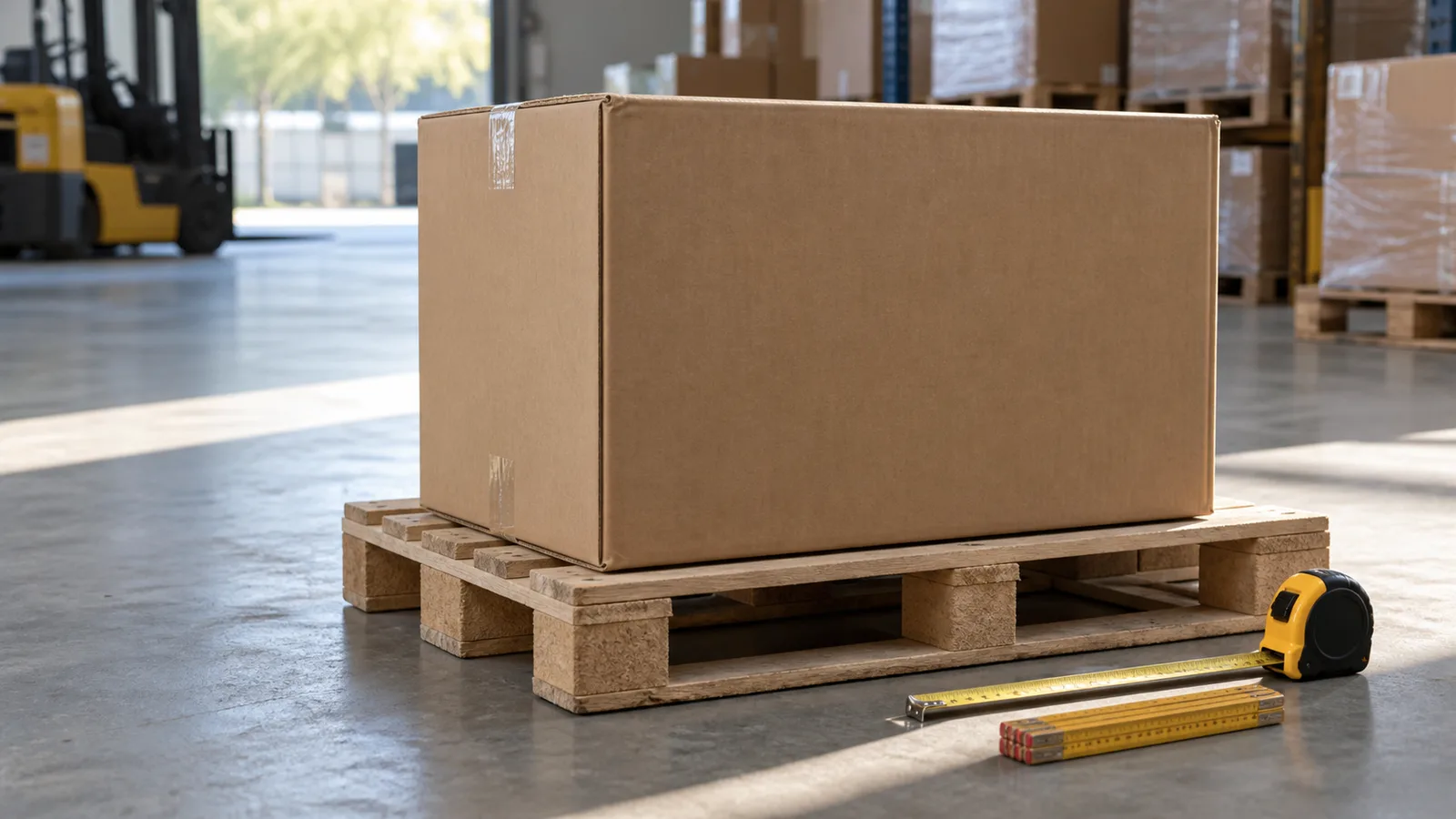
You can collect measurements and calculate a shipment’s volume in cubic metres.
CBM means volume in cubic metres. For a rectangular package, multiply external length, width and height in metres. Multiply that result by the number of identical packages. A quote also needs weight and handling restrictions: correct CBM alone does not make a complete transport enquiry.
Use this guide to obtain measurements from the supplier. Cargexo's existing planner is the next step for checking the arrangement of finished transport units. An approximate volume in an email cannot replace their dimensions.
Measure what will actually travel
For loose cartons, collect the cartons' external dimensions. For cartons already secured on pallets, measure the finished loaded pallets. Height includes the pallet; length and width include any overhang from wrapping, packaging or the product.
Do not add the cartons' volume again to the loaded pallets' volume. That counts the same space twice. Keep carton quantities as information about the contents, but use one consistent packaging level for shipment volume.
For irregular shapes, record maximum external dimensions and attach a drawing or photograph to the enquiry. Their product describes the bounding space, not the physical volume of the material. Ask the carrier or warehouse to confirm how these measurements will be accepted and charged.
Convert units before multiplying
Divide each centimetre measurement by 100 to obtain metres. Divide millimetres by 1000. Alternatively, divide the product of three centimetre measurements by 1,000,000; for millimetres the divisor is 1,000,000,000.
Fictional example: a 60 × 40 × 50 cm carton measures 0.60 × 0.40 × 0.50 m and occupies 0.12 m³. Twenty-five identical cartons occupy 3.00 m³. Treating 60 cm as 60 m creates an enormous error, so put the unit in every measurement column heading.
Do not combine centimetres and millimetres in one row without converting them. If a supplier sends 1200, 800 and 140, confirm the units rather than assuming that all three describe a standard pallet.
Calculate mixed cargo group by group
This example is fictional. Pallet dimensions include the pallet and finished packaging. Group A cartons travel separately; they are not on group B pallets.
| Group | Quantity | External dimensions, cm | Volume per unit | Group volume |
|---|---|---|---|---|
| A: loose cartons | 25 | 60 × 40 × 50 | 0.12 m³ | 3.00 m³ |
| B: loaded pallets | 4 | 120 × 80 × 150 | 1.44 m³ | 5.76 m³ |
| Total | 29 units | Two different groups | — | 8.76 m³ |
Calculate each group first, then add 3.00 + 5.76 = 8.76 m³. Do not average different package dimensions. Average length multiplied by average width and height can differ from the sum of the actual package volumes.
Retain precision during calculation and agree the rounding used for the quote. Rounding each small package upward before multiplication can change the batch considerably. Conversely, a highly precise result cannot correct measurements taken before final packing.
Why volume does not prove fit
Two shipments with identical CBM can require different floor areas. Several small cartons cannot substitute for a long crate merely because their total volumes match. Door clearance, rotation, stacking and handling access also matter.
A non-stackable pallet leaves space above it that cannot freely be used. Do not invent a taller physical measurement to “include the air.” Supply the real dimensions and state the stacking restriction separately; the service provider must confirm the charging basis.
For less-than-container-load, or LCL, shipping, the comparison between weight and volume and a tariff minimum may affect charges. Do not assume a universal conversion or rounding rule. Ask for the billing unit in the actual offer.
Send this request to the supplier
Please provide a table of finished transport units: quantity, length, width, height, measurement unit and gross weight. Include packaging, pallets and projections. State non-stackability, rotation restrictions and cartons travelling loose separately. Where cartons are already on pallets, do not add their volume again to the loaded pallet volume.
Check one unit in each group, each group total and the whole shipment total. Retain the original measurements beside calculated CBM. If packaging changes, you can recalculate without reconstructing the assumptions.
Related guides: Loading plan ·
Sources and scope
- Hapag-Lloyd — 20′ StandardSource checked: 2026-09-13
Example from this carrier’s fleet; manufacturers vary. Catalogue interior and door dimensions support the comparison; confirm the actual allocated unit.
- IMO/ILO/UNECE — CTU CodeSource checked: 2026-09-13
2014 code of practice for packing cargo transport units. Inspection, packaging and securing are distinct from geometric fit; the code is not approval of a particular shipment.
Editorial information
Author: WR
Published · Published: 13/09/2026 · Content updated: 13/09/2026